



Enabling precision, reliability and performance in critical environments
In a rapidly evolving geopolitical context, photonic technologies are playing an increasingly strategic role in defence and security. Optical sensors, imaging systems, detection devices and miniaturised components now require manufacturing processes capable of achieving extreme levels of precision and reliability.
Photonics enables the miniaturisation of systems, improves sensor performance and enhances the robustness of equipment used in critical environments. In this context, high-precision laser technologies have become essential tools for producing complex components that meet the requirements of defence and aerospace applications.
Within this landscape, LASEA develops laser micromachining solutions that support industrial players and research centres in manufacturing advanced technical components for next-generation systems.

Laser processes at the core of defence technologies
Systems used in defence and security rely on a wide range of optical, mechanical and electronic components. Manufacturing these elements requires processes capable of producing extremely fine structures while ensuring perfect repeatability.
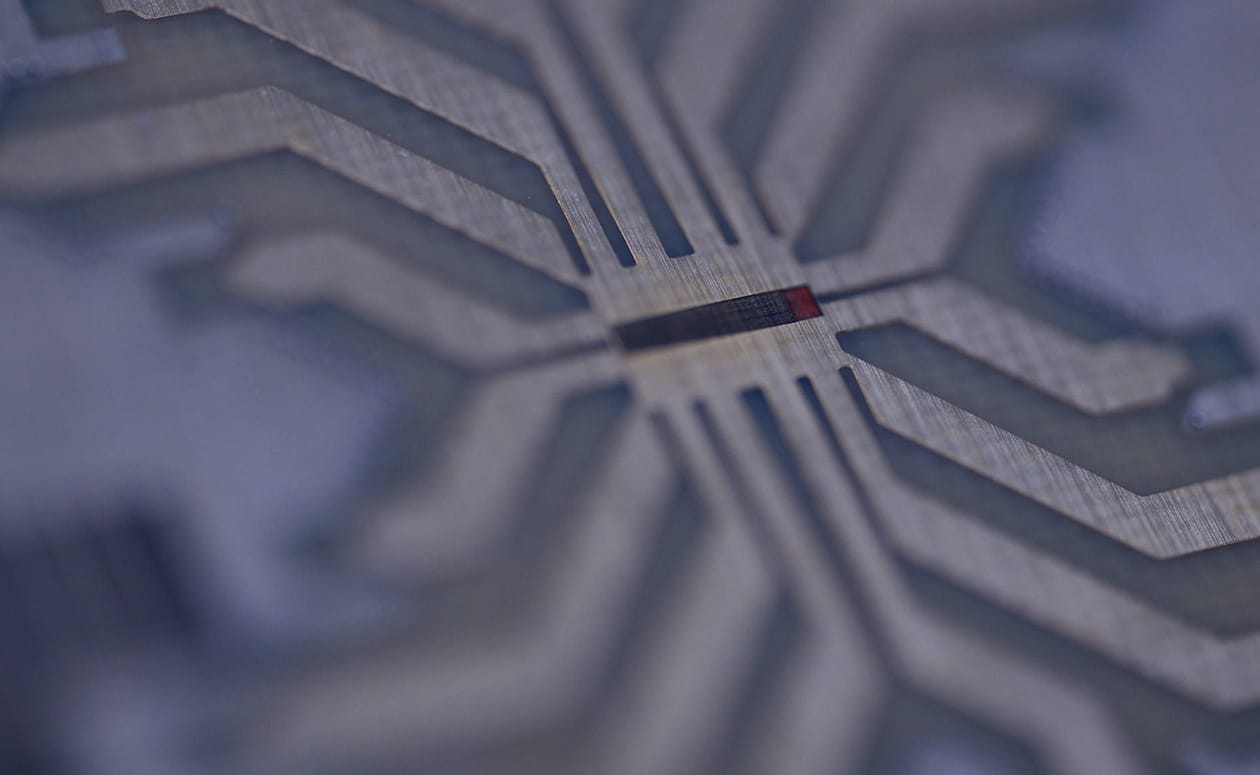
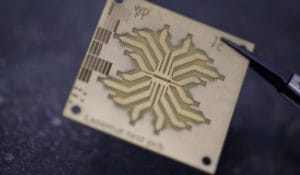
Laser micromachining technologies enable operations such as cutting, drilling, surface structuring and functional engraving with micrometre-level precision. They are now complemented by advanced laser micro-welding solutions, which are essential for the reliable assembly of miniaturised components without excessive thermal stress or alteration of sensitive materials.
These processes offer several key advantages for defence applications:
high manufacturing precision
excellent process repeatability
the ability to produce complex geometries
reduced number of production steps
high-precision assembly enabled by laser micro-welding
Thanks to ultrafast lasers and modular machine architectures, these technologies can process a wide range of technical materials used in optical, electronic and mechanical systems.
As an expert in laser micromachining and micro-welding, LASEA develops high-precision solutions for the most demanding defence applications. Its femtosecond and picosecond technologies enable advanced surface functionalisation—hydrophobic, hydrophilic, stealth, high heat dissipation or optimised tribological properties—as well as the machining and assembly of ultra-precise electronic and mechanical components.
In addition, LASEA develops pulsed laser effectors integrated into counter-drone systems (C-UAS), designed for the neutralisation of short-range swarms of mini-drones.

Machines designed for the most demanding industrial environments
Defence applications require extremely high standards in terms of precision, stability and process reliability. LASEA’s laser systems are designed to meet these requirements by combining ultrafast lasers, modular architectures and advanced control software.
LASEA machines enable micromachining operations with micrometre-level precision while ensuring excellent repeatability. They are used both in research and development, to explore new photonic applications, and in industrial production, where process stability is critical.
This approach is reinforced by the capabilities of the LASEA LAB, where engineers and experts develop, test and optimise laser processes in close collaboration with clients. The LAB enables application feasibility validation, parameter optimisation and a faster transition from R&D to industrial production.
Thanks to their modular architecture, these systems can integrate various laser configurations, vision systems, positioning axes and automation solutions. This flexibility allows processes to be adapted to the complex materials and geometries encountered in defence, aerospace and advanced technology sectors.
Photonics and defence: frequently asked questions
Photonics enables the development of increasingly advanced optical and electronic systems. In the defence sector, it is used to enhance sensors, imaging systems, detection devices and miniaturised components.
These technologies improve the precision, reliability and robustness of equipment used in critical environments.
Laser micromachining enables the production of technical components with micrometre-level precision. These processes are used to structure surfaces, drill micro-features, cut complex parts and create functional markings.
They also help reduce the number of manufacturing steps while ensuring high process repeatability.
Several laser micromachining processes are used in this field, including:
high-precision laser cutting
laser drilling
surface structuring
functional laser engraving
These processes enable the production of components for advanced optical, electronic and mechanical systems.
LASEA machines combine ultrafast lasers, modular architectures, vision systems and advanced control software.
This combination ensures high precision and excellent repeatability, both for R&D projects and for industrial production applications.
About LASEA
LASEA is an international specialist in high-precision laser micromachining. The company designs and manufactures laser systems for industries that require extreme levels of precision, reliability and flexibility.
Its technologies are used in sectors such as MedTech, microelectronics, watchmaking, aerospace and advanced research, where mastering manufacturing processes is critical.
By combining ultrafast lasers, modular architectures and proprietary software, LASEA supports its customers at every stage of their projects, from research and development to industrial production.